Pillows & Sleep Support
How to Adjust an Obasan Pillow for Side and Back Sleeping
An adjustable pillow offers an uncommon luxury: the chance to change the object rather than spend another week trying to change your sleeping habits. With an Obasan pillow that has removable filling, small, deliberate adjustments can help bring the head and neck into a more comfortable position. The useful question is not simply how full the pillow should be, but how its height works with your shoulders, mattress, and preferred way of sleeping.
Published November 23, 2026
The pillow is part of a system
A pillow is often judged by a quick test: press it with a hand, admire its loft, and decide whether it seems soft or firm. The test is understandable and not especially informative. A pillow does not support a hand in the same way it supports a head, and a pillow that feels substantial in a store or on a neatly made bed may behave quite differently after a sleeper settles into it.
For sleep, the relevant issue is the relationship between the head, neck, and torso. A pillow should fill enough of the space between the head and mattress to keep the neck comfortable and reasonably aligned with the rest of the spine. It should not force the head upward, allow it to fall too far, or make the sleeper hold an awkward position for hours. There is no single ideal loft that applies to everyone. The same pillow may suit one person and feel plainly wrong to another.
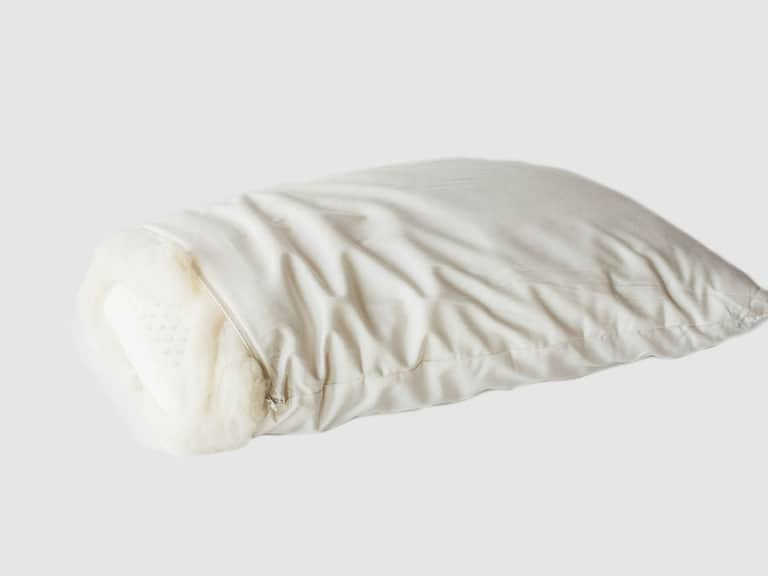
That is where an adjustable pillow can be useful. Some Obasan pillows have removable filling, allowing a sleeper to alter the loft and feel rather than accept a fixed amount of material. Depending on the model, the filling may include shredded latex, wool, or a combination of materials. Construction and care instructions vary, so the first step is to check the label or model-specific guidance. An adjustable pillow is not necessarily washable throughout, and removable fill does not mean every component should be washed.
Think of the adjustment as a fitting, not a transformation. The aim is not to engineer a perfect posture by force. It is to find a comfortable starting height that avoids obvious strain and stays comfortable in the sleeping position you actually use.
Begin with your sleeping position
Side and back sleeping create different spaces for a pillow to fill. On your side, the head is separated from the mattress by the shoulder and the side of the face. On your back, the shoulder sits more directly on the mattress, and the head needs a different kind of support. A pillow set up for one position may feel too tall or too low in another.
Before removing or adding filling, spend a moment noticing what you do at night. Do you settle on your side and remain there? Do you begin on your back but roll onto your side? Do you change positions repeatedly? The answer matters. Someone who moves between side and back sleeping may prefer a middle-ground loft, or may find that a pillow’s shape and adjustability help accommodate both positions. Trying to make one setting perfect for every posture can, however, become a small nightly negotiation with the bedding.
Also consider the mattress. A softer mattress lets the shoulder and upper body sink farther; a firmer surface keeps them higher. Because the pillow fills the remaining space between the head and the bed, mattress firmness can change the amount of loft that feels comfortable. A pillow cannot be fitted in isolation from the surface beneath it.
Finding a useful loft for side sleeping
For many side sleepers, the pillow needs to bridge the gap between the mattress and the head without tilting the neck sharply upward or letting it sag downward. Shoulder width is one part of that gap. A person with broader shoulders may need more height than someone with narrower shoulders, though mattress softness, body shape, and personal comfort all influence the result.
Lie on your side in your ordinary sleeping position, with your shoulder resting on the mattress rather than perched on the pillow. Notice whether your head seems to tip toward the mattress or angle up toward the ceiling. A mirror or a photograph taken from behind, with help from another person if available, can sometimes make the position easier to assess. The point is not to enforce a ruler-straight line; it is to notice whether the setup feels neutral and comfortable rather than strained.
If the pillow feels too low, the head may dip toward the mattress, leaving the neck bent to the side. If it feels too high, the head may be pushed upward. Either position can become tiring. A sense of pressure, repeated readjustment, or waking with stiffness may be a reason to reconsider the setup, although discomfort can have many causes and does not by itself diagnose a medical problem.
With an adjustable Obasan pillow, add filling in small increments if you need more height, or remove a modest amount if the pillow seems to crowd the space above your shoulder. Shredded latex can feel springy and substantial; wool can have a different, more yielding character. The amount alone does not tell the whole story, because materials distribute and compress differently. After each change, smooth the filling across the pillow rather than leaving a high mound in the center or an empty hollow where your head will rest.
Side sleepers often benefit from checking the shoulder as well as the neck. If the shoulder is pushed awkwardly forward or trapped under the pillow, the problem may not be loft alone. A pillow is not a substitute for comfortable positioning of the whole upper body, and simply adding more filling can sometimes make a cramped arrangement worse.
Finding a useful loft for back sleeping
Back sleepers generally have less distance for the pillow to bridge than side sleepers do, so a high pillow may push the head forward and bring the chin toward the chest. A pillow that is too flat may let the head tip backward or leave the neck feeling unsupported. The target is a comfortable position in which the head is supported without being forced into a pronounced angle.
Lie on your back and let your shoulders settle naturally. Notice whether the pillow supports the curve at the back of the neck as well as the weight of the head. A comfortable pillow does not need to fill every visible space, and a sleeper need not maintain a rigid pose. It should feel as though the head can rest without constant muscular effort.
If your chin seems pushed toward your chest, or the pillow lifts the head markedly above the torso, remove a small amount of fill. If the head feels unsupported and tips backward, a little more loft may help. Make only one change at a time. It is difficult to learn from a trial if several adjustments happen at once—or if the pillow is reshaped, rotated, and paired with a different mattress topper all in the same evening.
Some sleepers use a pillow with a contour or a distinct shape. In that case, placement matters as well as height: follow the design’s intended orientation, and do not assume that an adjustable fill pouch makes every surface equally supportive. If the pillow’s construction is unfamiliar, check its care and use guidance before opening it.
A gradual adjustment routine
The most reliable method is deliberately unexciting. Begin with the pillow in its current configuration and note what feels wrong, if anything. Then change the amount of filling slightly, close the pillow securely, redistribute the material, and try it for a while in your usual position. A few minutes of lying down can reveal an obvious mismatch; it may take more than one night to decide whether a small adjustment is genuinely better.
- Set a baseline. Note your sleep position, how the pillow feels at bedtime, and whether you tend to wake with pressure or stiffness.
- Open it carefully. Use a clean, dry work surface and follow the opening instructions for the specific pillow. Keep the zipper and seams away from unnecessary strain.
- Change one thing. Remove or add a modest quantity of fill rather than making a dramatic alteration.
- Spread the filling evenly. Gently redistribute it so the pillow supports the intended area without clumps or bare patches.
- Close and test. Secure the zipper fully, return the pillow to its usual cover, and try it in the position you are fitting.
- Keep a brief record. Write down what changed and how it felt the next morning. This is more useful than relying on a hazy impression several adjustments later.
There is no need to pursue precision to the last handful. The object is a comfortable, repeatable arrangement, not a laboratory instrument. If you are uncertain whether a change helped, return to the previous configuration and try again later. Being able to reverse an adjustment is one of the advantages of removable filling.
Keeping loose filling manageable
Loose latex or wool filling is lightweight in theory and surprisingly good at finding the floor in practice. Prepare before opening the pillow. Choose a dry, uncluttered area; keep pets and open windows out of the immediate scene if possible; and set aside a clean container or bag for removed material. A large bowl, clean storage tub, or resealable bag can make the adjustment less like a domestic weather event.
Work with small amounts and avoid pulling sharply at the fill or casing. If shredded material is difficult to handle, adjust over a larger container or on a clean sheet that can be gathered afterward. Keep any removed filling clearly identified and store it somewhere dry, clean, and protected from dust. Do not compress it into a damp or airtight place if the manufacturer’s instructions advise otherwise.
When the pillow is open, take the opportunity to notice its inner construction, but resist the temptation to wash parts simply because they are accessible. Latex cores and loose fills often require different care from removable fabric covers. Follow the instructions for the exact Obasan model. For a pillow whose core is not washable, use a pillowcase or protector and clean only the components described as washable.
After adjustment, close the zipper completely and check that no material is caught in the teeth. Gently fluff or shape the pillow to settle the filling, then give it a little time to recover before judging the final feel. Avoid exposing latex to direct sunlight or heat unless the maker specifically says otherwise; heat and intense sunlight may damage latex over time.
Common missteps—and what they reveal
Adding a great deal of fill at once. A dramatic change can make a pillow feel unfamiliar without showing which amount would have worked. Small steps preserve useful information.
Judging the pillow by its appearance. A high-looking pillow is not necessarily a high-support pillow, and an appealingly full surface can still be uncomfortable under the weight of the head. Test it in position.
Adjusting for the wrong sleep position. If you mostly sleep on your side, a back-sleeping test may not answer the question. Fit the pillow to the posture you use most often, then consider how it behaves when you move.
Changing several bedding elements together. A new mattress topper, pillowcase, and pillow fill can each affect the feel. Change one variable at a time when practical.
Assuming every model has the same care rules. Obasan pillows differ in materials and construction. Some covers may be removable or washable while the fill or core is not. Read the model-specific directions rather than relying on a general rule about “natural” pillows.
Expecting a pillow to solve persistent pain. A better fit may improve comfort, but it cannot identify or treat every cause of neck, shoulder, or back pain. If pain is persistent, severe, or accompanied by other concerning symptoms, speak with a qualified health professional.
When one pillow has to serve two positions
Many sleepers are not loyal to a single position. They begin on their back, roll to the side, and return sometime before morning, as if conducting an unannounced survey of the mattress. For them, an adjustable pillow is a compromise in the literal sense: a setting that remains comfortable enough through more than one posture, rather than a perfect fit for a position they rarely maintain.
Try the pillow first in the position you spend the most time in. Then make a brief check in the other position. If a loft that works on your side feels too tall on your back, consider a modest reduction and assess whether it still provides sufficient side support. If you regularly change positions, the answer may be a middle setting. That is not a failure to optimize; it is an acknowledgment that sleep involves movement.
A pillow’s shape may also matter. A contour, a baffle, or separate chambers can change how filling behaves when the pillow is turned. If a design has a clear intended orientation, preserve it during testing. And if you discover that no single setting feels comfortable for both positions, it may be more practical to prioritize the position in which you spend the most time, rather than continually remaking the pillow.
A practical measure of success
The best setting may not announce itself. Often, success is quieter: less urge to bunch the pillow, less need to move it under the neck, a head that feels supported without being propped up, and a morning that brings no new discomfort from the night’s arrangement. One comfortable night is encouraging, but a consistent result is more persuasive.
Keep the setting that feels natural, even if it does not look especially lofty or satisfy an abstract idea of what a side sleeper or back sleeper is supposed to use. Shoulder width, mattress firmness, fill behavior, and personal preference all contribute. A useful adjustable pillow does not prescribe a posture; it gives the sleeper a chance to find a workable one.
For an Obasan pillow, that process begins with modest changes, careful handling, and attention to the particular model’s construction. Remove or add filling gradually, redistribute it evenly, and test the result where it matters: under your head, on your own mattress, in the position in which you actually sleep. The right adjustment is usually less dramatic than the search for it.
Quick checklist
- Check the specific pillow’s materials, construction, and care directions before opening it.
- Consider shoulder width and mattress firmness alongside sleeping position.
- For side sleeping, look for comfortable support across the space between shoulder and head.
- For back sleeping, avoid a height that pushes the head conspicuously forward or leaves it unsupported.
- Adjust in small increments and change one factor at a time.
- Keep loose fill clean, dry, and contained; do not wash the core unless its instructions allow it.
- Judge the result by comfort over time, not by the pillow’s appearance alone.