Pillows · Materials & care
What Wool Fill Means for Pillow Loft, Airflow, and Care
A wool pillow can be lofty, yielding, springy, or surprisingly compact. The difference often has less to do with the word wool on a label than with what happens inside the case: batting, small resilient puffs, or another arrangement of fiber. That construction shapes the pillow’s feel, its airflow, how easily its height can be changed, and the amount of attention it will ask of you.
A pillow is a modest object with an outsized job. Each night it must accommodate the particular geometry of a human head, neck, shoulder, mattress, and sleeping posture, often without attracting attention to itself. When it succeeds, it disappears. When it fails, it becomes a piece of furniture one negotiates with at three in the morning.
Wool enters this negotiation with a useful set of qualities. It is a natural fiber that can absorb moisture vapor and release it into the surrounding air, and it tends to feel less clammy than some dense fills. It also has resilience: when fibers are arranged with enough space and structure, they can compress under weight and recover to a degree. But “wool pillow” does not describe a single design. A pillow made from layered batting is not necessarily going to feel like one filled with small wool puffs, and neither is automatically right for every sleeper.
Understanding the construction is therefore more useful than trying to identify a universally superior fill. Loft, support, and care are connected to the shape and amount of the wool, the casing around it, and whether the pillow can be opened. The label is not fine print; it is the beginning of the story.
Loft is height, but support is a relationship
Loft is the pillow’s height when it is resting in its ordinary, uncompressed state. It is easy to measure, at least in theory, and easy to misunderstand. A pillow may look full on a bed and still compress substantially beneath the head. Another may appear relatively modest but resist compression, maintaining a steadier platform through the night. What matters is not simply how tall the pillow looks, but how much of that height remains when it is doing its work.
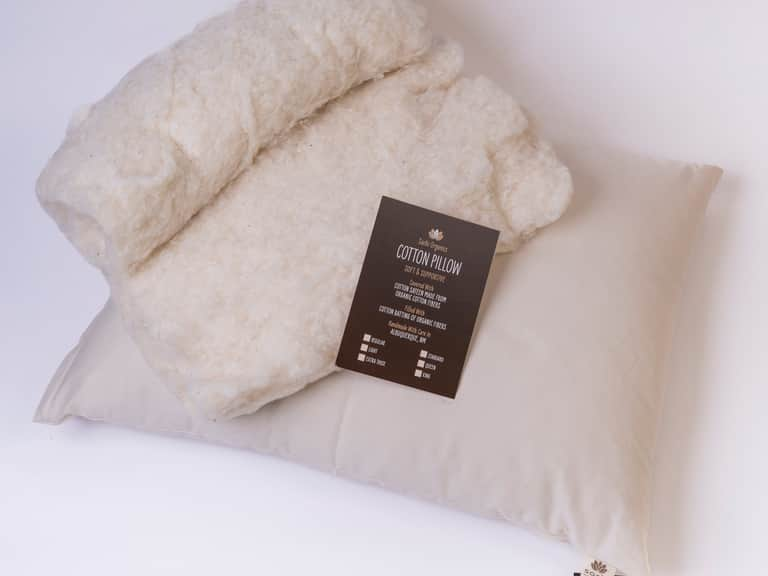
Wool batting is made by arranging fibers into sheets or layers. In a pillow, those layers can give the fill a soft, somewhat even feel. Batting may be quilted or otherwise held in place so that it does not migrate too dramatically, although construction varies. Over time, a batting-filled pillow may settle as its fibers are compressed by regular use. This is not necessarily a defect; natural fills can change. But a sleeper who wants to restore the original height by taking out a handful of stuffing may find that a fixed, layered construction offers no such invitation.
Wool puffs, sometimes called wool balls or wooly bolus, are small bundles of fiber rather than broad sheets. Their rounded form creates pockets of space within the pillow and can make the fill feel more buoyant or billowy. A pillow filled with puffs may also allow the interior to shift more freely as the sleeper moves. The effect depends on the size, density, and quantity of the puffs, as well as the cover’s construction. The words “wool puffs” alone cannot tell you whether a pillow will feel soft or firm.
Some wool pillows can be adjusted through a zipper, letting the sleeper remove or redistribute fill. Others are sewn closed, or have an opening intended for access but not for routine adjustment. A zipper is a practical feature only if the construction behind it permits safe, manageable adjustment. Loose fibers may be messy to handle, and fill removed in an enthusiastic first experiment cannot always be returned neatly. It helps to ask whether the pillow is adjustable, how the adjustment works, and whether the maker supplies guidance for storing unused material.
For side sleepers, height is often a central consideration because the pillow must help occupy the space between the shoulder and the head. Back sleepers may prefer less loft, depending on their body and mattress. Stomach sleepers often seek a flatter surface. These are useful starting points, not laws. A soft mattress may allow the shoulder to sink farther than a firm one; a broad shoulder, a narrow frame, and personal comfort all affect the equation. A pillow’s shape and compression are as important as its advertised sleeping-position category.
Airflow and the quiet work of wool
Wool’s reputation for temperature regulation is best understood without expecting it to behave like an air conditioner. A pillow cannot control the temperature of a room or the body. What its materials and construction can influence is the small climate near the face and neck: how readily heat and moisture move away from the surface, and whether the pillow feels stuffy or damp during ordinary use.
Wool fibers can absorb moisture vapor and release it gradually. In a pillow, that characteristic may help moderate a humid or clammy sensation, though results depend on the sleeper, the room, the cover, and the amount of ventilation around the fill. A tightly packed pillow with a dense casing will not behave exactly like a loosely filled one. A breathable cotton shell may allow more exchange than a coated or laminated fabric, while a separate pillow protector adds another layer that can either preserve a sense of openness or make the surface feel warmer, depending on its material.
The shape of the fill matters here, too. Small puffs may leave spaces between fiber bundles; layered batting may present a more continuous structure. Neither arrangement guarantees a cooler night. The useful question is whether the whole pillow—fill, inner casing, protector, and pillowcase—fits the conditions in which you sleep. If you tend to sleep warm, investigate those layers rather than relying on a single adjective such as “breathable.”
Wool is also sometimes described as hypoallergenic or naturally resistant to dust mites. Such statements can be too sweeping when applied to an individual sleeper. Allergies have different causes, and sensitivity to wool itself is possible. A well-woven encasement and regular laundering of the washable layers can help limit dust and debris, but no pillow should be treated as a guaranteed solution to allergies or a substitute for medical advice. If you know you react to wool, “natural” is not a reason to ignore your own experience.
Two constructions, two different conversations
The distinction between batting and puffs becomes clearer when looking at real examples. The Alpaca and Wool Pillows combine alpaca fiber and wool batting in a 500-thread-count organic cotton cover. The product description emphasizes a plush, supportive surface and a tightly woven encasement. This is a blend: the feel cannot be attributed to wool alone, because alpaca is part of the fill. The listed information also identifies the cotton cover as GOTS-certified; readers who want to understand the certification claim for the entire pillow should check exactly which components and scope are covered by the seller’s documentation.
By contrast, the Certified Organic Snuggle Pillow uses GOTS-certified organic wool inside an organic cotton sateen shell and comes with a separate cotton case. Its care instructions draw a clear line between the pillow and that outer case: spot-clean the pillow, and wash the separate case in cold water, then line-dry or tumble-dry on low. That difference is central to ownership. The case can be refreshed in a washing machine; the wool-filled interior is not described as machine washable.
These examples should not be read as a contest. They illustrate how much sits behind the shared word wool. One pillow uses batting alongside alpaca fiber; another uses wool fill and a separate protective case. A person comparing them should ask about the overall loft, whether fill can be removed, which layer is washable, and what the manufacturer means by organic certification. The answers are more useful than a general promise that wool is comfortable or sustainable.
Care: the pillow and its cover are not the same thing
One of the most consequential details on a pillow label is whether the fill itself can be washed. A removable cover can create a misleading impression that the entire object is machine-friendly. Often, only the outer casing or separate case is intended for laundering. Wool batting and loose wool fill may be damaged by the combination of water, agitation, heat, and improper drying. Shrinkage, clumping, distortion, or a lingering damp interior are all reasons to follow the maker’s directions rather than improvising.
Before buying, identify each layer: the pillow core, any inner casing, the removable outer cover, and the pillowcase you provide yourself. Then note the care instructions for each. “Machine washable cover” is not the same as “machine washable pillow.” If the fill is spot-clean only, consider whether that routine suits your household, especially if the pillow will be used by a child, during travel, or in a setting where spills are likely.
A washable pillow protector can reduce how often the core needs attention. It sits between the pillow and the pillowcase, catching ordinary skin oils and dust before they reach the fill. Its benefits depend on the fabric and fit; a protector that is difficult to remove may not be used consistently, and an impermeable layer may change the pillow’s feel or warmth. Wash the protector according to its own instructions, and make sure it is fully dry before replacing it.
For a pillow whose instructions specify spot cleaning, use a restrained approach. Blot a small area rather than soaking it, and avoid rubbing that can distort the fill. Follow the maker’s guidance on cleaning agents, drying, and whether the casing can be opened. Never assume that sunshine or direct heat is appropriate: some natural materials can be affected by prolonged exposure. If a pillow gets thoroughly wet, contact the manufacturer for specific advice rather than enclosing a damp core in a fresh case and hoping for the best.
Air circulation can be part of a simple upkeep routine. Allowing a pillow to air in a dry, shaded, well-ventilated place may help it feel fresher between washes. Fluffing or turning it can redistribute fill, particularly in a pillow with loose puffs, but it will not restore material that has permanently settled. A pillow that smells musty, remains damp, or has developed a persistent stain may need more than a change of case.
Reading organic and natural claims carefully
“Natural” and “organic” are not interchangeable terms, and neither word tells the whole story of a finished pillow. A product can contain natural fibers without every component being certified organic. The cover, sewing thread, fill, processing, and final assembly may each have separate specifications. A certification can help verify claims within its defined scope, but shoppers should still look for the named standard, the certified component, and the documentation that connects the claim to the item being sold.
GOTS—the Global Organic Textile Standard—is a textile processing and product standard with requirements that extend beyond the origin of a fiber. When a seller says “GOTS-certified,” the relevant question is what exactly is certified: a textile, a facility, a supply chain, or a finished product. A phrase in a product description is not a substitute for checking the certificate or asking the retailer to clarify. The aim is not suspicion for its own sake; it is precision.
Wool sourcing also raises questions distinct from certification: where the wool comes from, how it is processed, and what information the company provides about animal welfare and supply-chain practices. A transparent label does not need to transform the pillow into a moral treatise. It should, however, give the reader enough detail to distinguish a verified claim from an appealing but undefined one.
A practical checklist before you choose
When comparing wool pillows, a short list of concrete questions can keep the decision grounded in the way you sleep rather than in a catalogue’s most lyrical adjectives:
- What is the fill construction? Look for batting, wool puffs, loose fiber, or a blend. Ask how that arrangement is likely to affect feel and compression.
- Can the loft be adjusted? Check for a zipper and find out whether fill can be removed or added. If the pillow is fixed, make sure its listed height and feel suit your preference.
- Which part can be washed? Separate the care instructions for the core, removable cover, and any included case. Do not infer that the whole pillow is washable from a washable cover.
- What will protect the fill? A compatible pillow protector may simplify routine cleaning. Confirm that it fits and does not make the pillow uncomfortably warm.
- What does the certification cover? Identify the standard and the certified material or product. Ask for clarification if the label is broad but the supporting detail is not.
- Does the loft suit your position and mattress? Consider how far your head and shoulder sink, not just how tall the pillow appears on the bed.
- Are you comfortable with the maintenance? Spot-clean-only fill can be a sensible choice, but it asks for a protector and a little more care around spills.
If possible, allow a new pillow a few nights of ordinary use before making a final judgment, while observing the retailer’s return conditions. Notice whether your neck feels at ease, whether the pillow stays in place, and whether you find yourself folding it or pushing fill away. These small acts are information. A pillow that requires constant negotiation may not be the right height or construction, however impressive its material credentials.
The right wool pillow is the one you can live with
Wool can offer a breathable, resilient alternative to synthetic fill, but it is not a single sensation or a promise of perfect sleep. Batting may suit someone who prefers an even, softly structured pillow. Wool puffs may appeal to someone drawn to a more pliable fill, especially if the design permits adjustment. A separate washable case may be valuable to one household; a spot-clean-only core may be an inconvenient compromise to another.
The most reliable way to compare organic wool pillows is to begin with the construction and end with the care label. Ask what is inside, how it is held in place, whether the loft changes, and which pieces can be washed. Then weigh those answers against the way you sleep, the temperature of your room, and the amount of maintenance you are willing to accept. The best pillow is rarely the one with the most confident claim. It is the one whose materials, height, and instructions make sense when the room is dark and the day is over.
Frequently asked questions
Does wool fill make a pillow firmer?
Not necessarily. Firmness depends on the amount and arrangement of the fill, the casing, and how much the pillow compresses under the head. Batting and wool puffs can feel different, but neither construction guarantees a particular firmness.
Can I wash an organic wool pillow in a washing machine?
Only if the maker’s instructions explicitly say that the pillow fill can be machine-washed. Many wool pillows are spot-clean only, even when their removable covers or separate cases can be laundered. Check the care label before washing.
What is the difference between wool batting and wool puffs?
Batting is arranged in layers or sheets; puffs are small bundles of fiber. The construction can affect how the fill shifts, compresses, and can be adjusted. The exact feel still depends on the pillow’s design and the quantity of wool.
Are wool pillows suitable for people with allergies?
That depends on the individual. Some people value wool and the way it handles moisture, while others may be sensitive to wool or to materials elsewhere in the pillow. A washable protector and regular care of removable layers can help with routine cleanliness, but a pillow should not be treated as an allergy treatment.